
SQL TCL Commands

TCL Commands in SQL

Transaction Control Language (TCL) Command are used to manage transaction in database.
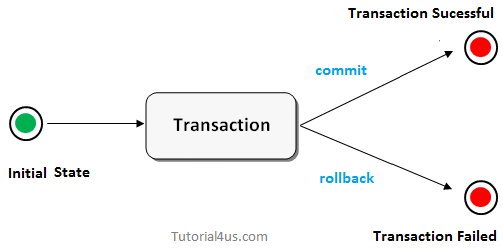
transaction management

TCL Commands

All TCL commands are given below;
  • commit
  • rollback
  • savepoint

savepoint

A SAVEPOINT is a point in a transaction when you can roll the transaction back to a certain point without rolling back the entire transaction.

Syntax

	
savepoint savepoint_name;

commit

The COMMIT command is the transaction command used to save changes invoked by a transaction to the database. The COMMIT command saves all transactions to the database since the last COMMIT or ROLLBACK command.

Syntax

	
commit;
Note: Transaction control commands are only used with the DML commands INSERT, UPDATE and DELETE only. They can not be used while creating tables or dropping them because these operations are automatically committed in the database.

Properties of Transaction managements

Every transaction follows some transaction properties these are called ACID properties.
Transaction Properties
Atomicity: Atomicity of a transaction is nothing but in a transaction either all operations can be done or all operation can be undone, but some operations are done and some operation are undone should not occur.
Consistency: Consistency means, after a transaction completed with successful, the data in the data store should be a reliable data this reliable data is also called as consistent data.
Isolation: Isolation means, if two transaction are going on same data then one transaction will not disturb another transaction.
Durability: Durability means, after a transaction is completed the data in the data store will be permanent until another transaction is going to be performed on that data.

Comments

Popular posts from this blog

Introduction of SQL

Introduction of SQL SQL (Structure Query Language)  was initially developed at IBM by Donald D. Chamberlin and Raymond F. Boyce in the early 1970s. This version, initially called SEQUEL (Structured English Query Language), was designed to manipulate and retrieve data stored in IBM's original quasi-relational database management system. Features of SQL SQL is not a case sensitive language. Every commands in SQL should ends with semicolon(;). SQL can also called as sequel (SEQUEL). SQL Sub Language SQL is mainly divided into four sub language Data Definition Language(DDL) Data Manipulation Language(DML) Transaction Control Language(TCL) Data Control Language(DCL) Only for remember You can remember all these command like below; DDL Commands "dr. cat" d-Drop, r-Rename, c-Create, a-Alter, t-Truncate. DML commands "sudi". s-Select, u-Update, d-Delete, i-Insert.

SQL Syntax

SQL Syntax SQL follows some unique set of rules and guidelines called  Syntax . Some basic guidelines related to SQL Syntax are given below; SQL is not case sensitive. Commonly SQL keywords are written in uppercase. You can write SQL statements in one line or in multiple lines. SQL are depends on relational algebra and tuple are relational calculus. SQL statement SQL statements are started with any of the SQL commands/keywords like SELECT, INSERT, UPDATE, DELETE, ALTER, DROP etc. and the statement ends with a semicolon (;). Syntax SELECT * FROM table_name; Why use semicolon after SQL statements ? Semicolon is used to separate SQL statements. It is a standard way to separate SQL statements in a database system in which more than one SQL statements are used in the same call. Some Basic Commands SELECT:  It is used for Retrive data from a database. UPDATE:  It is used for updates data in database. DELETE:  It is used for deletes data from da...

SQL Default Constraints

SQL Default Constraints Default Constraints  is used to insert a default value into a column. The default value will be added to all new records, if no other value is specified. My SQL or SQL Server or Oracle or MS Access create table Employee ( e_id number(3) NOT NULL,, e_name varchar(15), sal number(5), City varchar(255) DEFAULT 'Delhi', ); In above syntax in city column by default value for city of every employee is delhi. SQL DEFAULT Constraint on Alter Table My SQL ALTER TABLE Employee ALTER City SET DEFAULT 'delhi' SQL Server or MS Access ALTER TABLE Employee ALTER COLUMN City SET DEFAULT 'delhi' Oracle ALTER TABLE Employee ALTER City SET DEFAULT 'delhi' Drop Default Constraints My SQL ALTER TABLE Employee ALTER City DROP DEFAULT SQL Server or Oracle or MS Access ALTER TABLE Employee ALTER COLUMN City DROP DEFAULT